How to Pack Dry Dog Food for a Road Trip
The awkward moment usually comes at the overnight stop: the food is under the luggage, the scoop is somewhere else, and nobody remembers whether breakfast was already counted in the amount packed.
A workable system starts with the meals, not the container. Calculate what you need, keep the food identifiable, and choose storage you can carry inside and clean properly. This guide covers ordinary dry kibble, not raw, chilled or wet-food transport.
Affiliate disclosure: As an Amazon Associate I earn from qualifying purchases. This guide contains affiliate links; we may earn a commission if you buy through them. Read our disclosure.
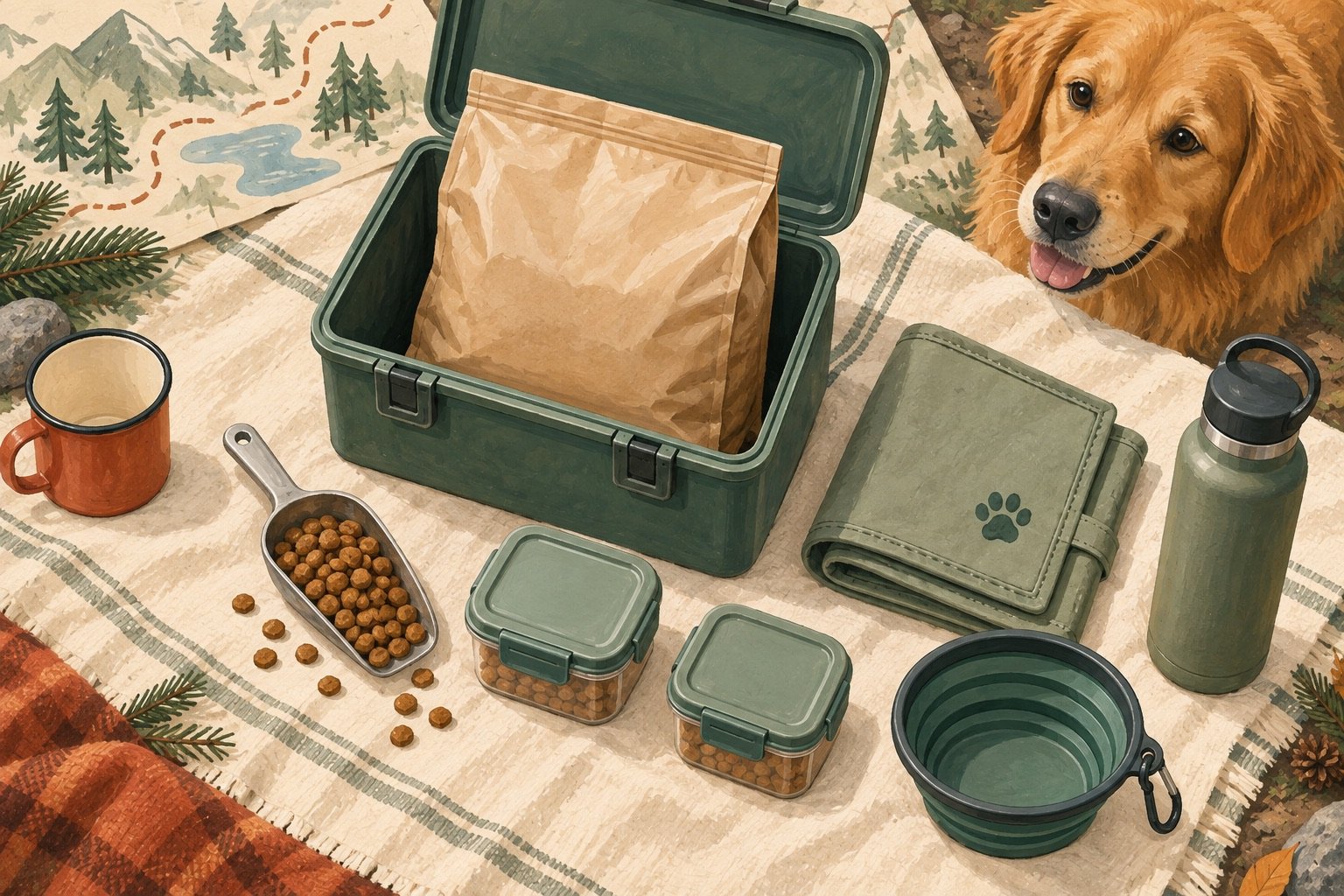
Count meals before choosing a bag
Use the daily amount your dog already receives under their established feeding plan. This is packing arithmetic, not advice on how much a dog should eat. Ask your veterinarian about diet or portion changes, particularly for a prescribed diet.
Total to pack = established daily amount x equivalent days of meals away + a separately chosen delay reserve.
Count the first and last day’s meals rather than automatically counting every calendar day as a full day. If you normally weigh food in grams, stay in grams. If you use a particular measuring cup, keep the same method instead of assuming a new container’s cup is equivalent.
| Packing worksheet | Your plan |
|---|---|
| Food name and exact formula | _____ |
| Established daily portion and unit | _____ |
| Meals needed, including departure and return | _____ |
| Total for planned meals | _____ |
| Delay reserve chosen for this route | _____ |
| Total packed in the same unit | _____ |
| Where the usual food can be obtained if plans change | _____ |
Example, not a feeding recommendation: A dog already eating 300 grams a day needs 1,200 grams for four full days. If the owner chooses one additional day’s reserve for that route, the packed total is 1,500 grams. The reserve is a planning choice, not a universal rule.
Keep the original packaging when possible
FDA storage guidance recommends retaining the original food bag and placing that bag inside an outer container rather than emptying it out. This also preserves the product identity, lot number, UPC and best-by date.
If transfer is necessary, FDA advises a clean, dry container with a close-fitting lid and keeping that identifying information. Wash and dry containers between bags. Store dry food somewhere cool and dry, below 80 F (about 27 C), and follow the food’s own instructions.
For a trip, our practical starting point is to see whether a suitably sized original bag fits your carrying setup. A small container that forces you to remove the packaging may not be the improvement it first appears to be. Photograph the label as a useful backup, not a reason to discard the bag.
Choose a storage layout that matches the trip
| Approach | When it may work | Tradeoff |
|---|---|---|
| Original food bag inside an outer container | You can fit and close the bag without crushing it or interfering with the lid | Packaging takes space, so loose-kibble capacity claims will overstate what fits |
| Roll-top food carrier | A flexible shape packs better with your overnight gear | Check bag fit, closure space, cleaning and drying; not temperature-controlled storage |
| Rigid pour-spout container | You specifically need a structured dispenser and can manage transfer carefully | Pouring assumes loose food, and seals and corners add cleaning work |
A container’s litre or cup capacity is volume; a “holds 3 lb” claim depends on the kibble. Do not convert between them with a universal formula. Leave room for the closure and any original packaging, then check your planned load before departure.
Two travel-storage options to compare
We reviewed three Amazon listings and shortlisted these two for their different layouts. Neither is a hands-on recommendation or a verified freshness guarantee. Check the exact selected variant, current instructions and return terms before buying.
Kurgo Kibble Carrier: flexible storage for an overnight kit
The Coastal Blue version has a roll-top closure, a lined interior, a side pocket and a bottom opening for a compatible bowl. Kurgo’s product page lists up to 5 pounds of dry food, approximately 20 cups of average-sized kibble. That approximation is not a conversion rule for your food, and the bowl is not included.
The appeal is organization: food and feeding accessories can travel together without another hard box. Before ordering, check whether your original food bag fits while allowing the top to close properly. If it does not, consider a different outer container rather than assuming decanting is required.
Limitations: We have not measured capacity, tested seals or checked resistance to a determined dog. A roll-top bag is not refrigeration or a pest-proof storage system. Kurgo’s US page specifies hand washing and air drying; follow the instructions supplied with the item.
View the Kurgo Kibble Carrier on Amazon (affiliate link)
TIOVERY small dispenser: useful only if the transfer tradeoff suits you
The selected grey version has a handle, four lid buckles, a pour spout and a measuring cup. Its listing calls the size “3 Qt,” while the capacity field says 3 litres. Those volumes are not identical, and the approximate 3-pound food claim depends on kibble density. Confirm usable capacity rather than planning to the advertised maximum.
Limitations: The spout is intended for loose food, so this is not our first choice for keeping a bag inside another container. If transfer is necessary, use the FDA guidance above and retain the current food identification. Check the seals, cleanability and cup markings before relying on it. “Airtight” is the seller’s claim; we have not leak-tested it or established any extension of food shelf life.
View the TIOVERY small food dispenser on Amazon (affiliate link)
Pack for arrival, not just the trunk
Put the food, dedicated measuring utensil and clean bowl where one person can retrieve them together. Keep cleaning equipment and used bowls separate. If another traveler might feed the dog, leave a short note with the usual portion, meal routine and whether the last meal was given.
At accommodation, choose storage that meets the food’s instructions instead of automatically leaving it in the car. A shaded parking space or insulated tote does not establish a controlled storage temperature. Plan ahead when suitable storage is uncertain.
Our large-dog travel-bowl comparison helps with bowl fit and packability. Bowl capacity should not become your measuring system.
Make cleanup part of the feeding routine
FDA handling guidance calls for washing hands before and after handling pet food and washing bowls and measuring utensils with soap and hot water after use. Use a dedicated scoop rather than dipping the feeding bowl into the food.
Before leaving home, work out where you will do that washing and where the equipment will dry. A wipe-clean marketing description is not the same as a full cleaning plan. If the container has a gasket, narrow spout or folded liner, read how those parts should be cleaned before the first use.
Five things to check before departure
- Planned meals and reserve are counted in one consistent unit.
- The food identity and current lot information are available.
- The actual load fits without straining the closure.
- The clean bowl and usual measuring utensil are accessible.
- Storage and washing arrangements are practical at each overnight stop.
Questions that come up
Do I need a special dog-food travel bag?
No. An appropriate outer container you already own may work with the original bag. Buy a travel carrier only if it improves the packing arrangement.
Does an airtight container keep food safe in a hot car?
Do not assume so. A seal does not control temperature. Follow the food manufacturer’s storage instructions and plan suitable storage.
How much extra food should I take?
Choose a reserve based on likely delays and access to the exact food. The worksheet calculates quantity; it does not prescribe a reserve or a feeding portion.
Keep planning
- A practical dog road-trip cleanup kit
- Organize your road-trip packing list
- Compare supplies-bag layouts
- Browse everyday travel gear
About this guide
Product listings, Kurgo specifications and FDA guidance checked September 20, 2026. This is document-based packing advice, not hands-on product testing or an individualized feeding plan. We have not verified the containers’ capacity, sealing performance or material certifications. Our editorial policy.